
Joshua Citarella
patreon
I recently spoke with Ezra Klein on Doomscroll #18. Klein is a co-author, along with Derek Thompson, of a new book titled Abundance.
Among the emerging political factions of the 2020s, few have been more influential than the rise of the tech-right. DOGE is currently transforming the administrative state in a way that could cripple the US for years to come. The question remains: can progressives offer a positive vision for our increasingly technological future?
Subscribe today and help make new episodes of Doomscroll.

Its been an interesting week online. There’s been an abundance of “Abundance discourse” on X (mostly coming from people who haven’t read the book). Counter to much of the online commentary, Abundance is not a clever rebranding of neoliberalism 2.0. Many reviews seem narrowly focused on housing policy or environmental building codes and miss the important subtext of the book — so I will say the quiet part out loud: superpower competition between the US and China will usher in a state-led New Deal in the fields of science and technology.
Drawing on the work of historian Gary Gerstle, the authors frame 20th century American history as a sequence of “political orders”, an ideological consensus shared across both political parties. They write;
The New Deal order rose in the 1930s and collapsed in the 1970s. The neoliberal order rose in the 1970s and declined in the 2010s.
When the spell of a political order breaks, ideas once regarded as implausible and unacceptable become possible and even inevitable. This happened in the 1930s, when the Great Depression created space for the rise of Roosevelt’s social democratic collectivism. It happened in the 1970s, when an upswing of individualism changed the way people thought about taxing and spending, regulating the economy, and managing our relationship to the environment.
It may be happening again.
To me, the granular policy discussions in Abundance seem less important than the authors’ acknowledgement of this macro scale shift in “political orders”. The neoliberal period is over but what comes next is still unclear. Superpower competition will be the driving force of 21st century politics. In the absence of an empowered workers movement, competition between the US and China will be the vector along which our political economy is transformed.
The core of this agenda —subsidies for computer chips and clean energy, historic investments in infrastructure— used the spur of China to get America building and manufacturing at home again. As in the 1930s, and again in the 1970s, external threats and internal crises are converging and making possible a new kind of politics.
Unlike previous eras, this Neo New Deal will not be a bottom up, trade union led push for economic redistribution. Instead, external competitive pressure will force a reduction in profit taking (the American capitalist class will take a haircut) and re-direct funds into R&D for new tech in energy and AI. The political transformation will not come from a benevolent social democratic state. Instead, the New Cold War paradigm raises concerns for US national security — we can’t rely on China for chips and green energy, so we’re going to make our own.
The book is written to appeal to a number of audiences, but most importantly it seeks to influence and set the agenda for Democratic party officials. Klein and Thompson brand themselves as the progressive counterpoint to tech-right figures like Elon Musk or Marc Andreessen. Bhaskar Sunkara has the correct take:
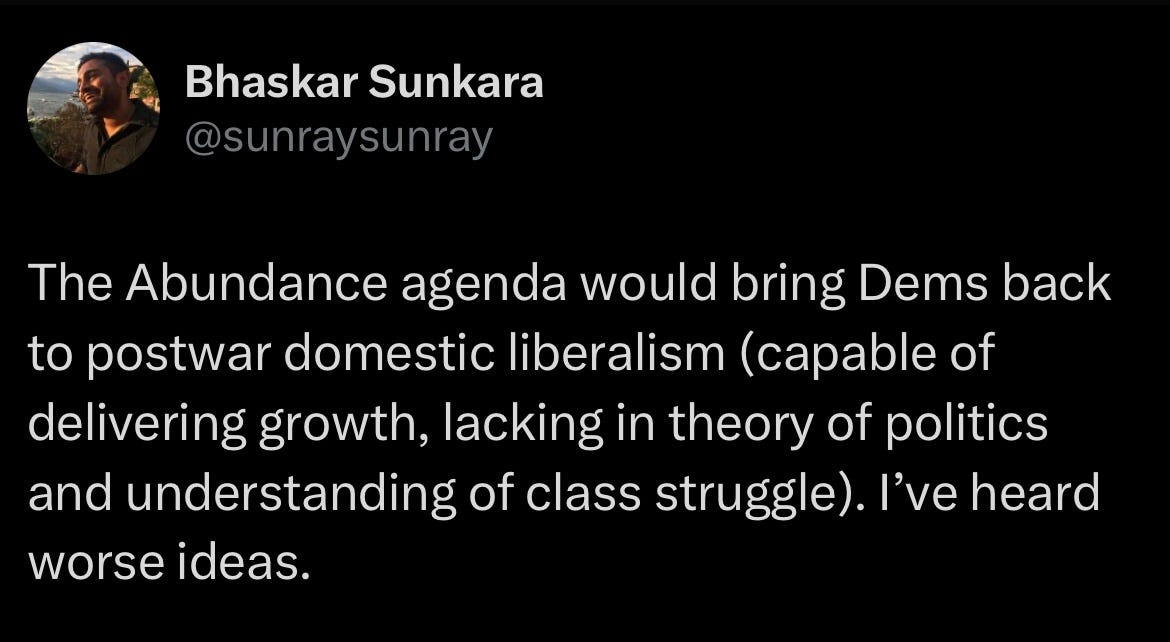
Abundance isn’t just a policy platform — its an observation of a shift that is already underway and will soon be expedited. New Cold War policies began under Biden and now continue under Trump. This continuity between both political parties helps to make visible an emerging consensus that will soon become the 21st century "political order". This is something we’ve been talking about for a while:
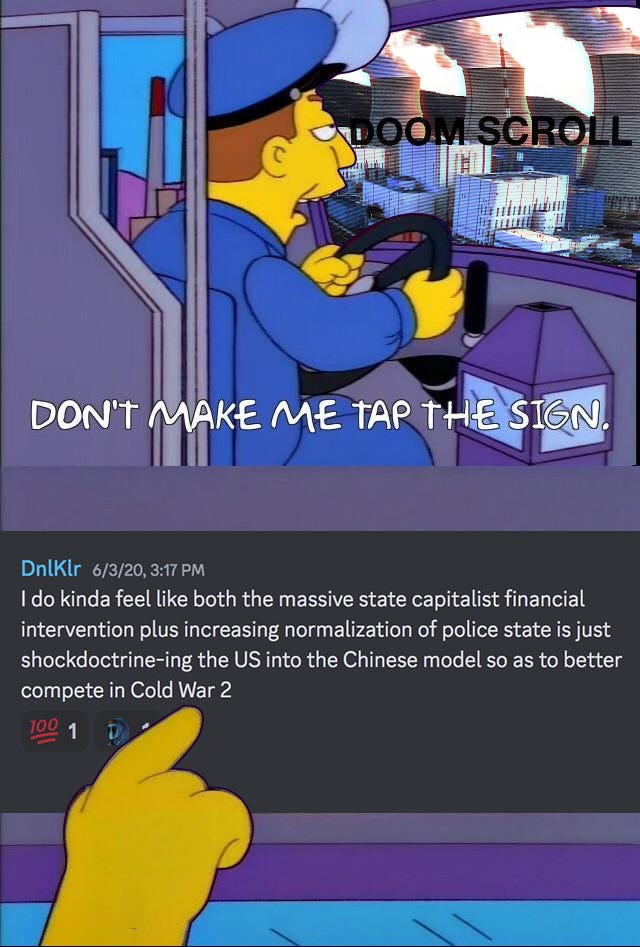
In part 2 of our discussion, Ezra and I explore the emerging political faction known as Degrowth, the carbon crisis and the policy arc of the neoliberal period. Revisiting the crisis of the 1970s tells us a lot about what state spending may look like in the near future. Subscribers can watch this week’s bonus episode: Doomscroll: Ezra Klein II
Compare this conversation to my episode with Daniel Keller: Doomscroll #12, from opposing sides of the political spectrum you will hear a similar call to lock down chips and the need for US energy independence. We are watching the emergence of a new political order.
***
Having grown up in the 90s, its strange to see ideology now make a come back. History was supposed to be over. Until recently, it was considered naive to actually believe in anything. Today, big political visions are back in style and more things seem possible than at any time in living memory.
Longtime listeners of the podcast, and readers of this newsletter, will know that these topics of design, technology and political imagination, have long been a focus of my writing and research. My interest in the broad genre of left futures (coincidentally the title of my exhibition at BFI in Miami, FL in 2021), began with the seminal text Capitalist Realism by Mark Fisher. In the wake of the 2008 financial crisis, Fisher asks: why did no alternative political vision arise to counter the crises of neoliberalism?

On an earlier podcast, Nick Srnicek recounts long discussions between himself, co-author Alex Williams and Mark Fisher, as they search for a way to rekindle the left’s political imagination. To them, it was clear that a politics of compromise, harm reduction and crisis management had already failed. What was needed was a new utopian imaginary that the left could proactively move toward.
Nick Srnicek on Platform Capitalism
Inventing the Future (2015), by Srnicek and Williams, is the essential left accelerationist text. It proposes a massive state-led investment into automation and a policy of universal basic income. Online, these ideas quickly became memeified into a long tail e-deology known as “Fully Automated Luxury Communism”. A few years later, this memetic discourse helped to inspire Aaron Bastani, host of Novara Media’s Downstream podcast, to build upon these themes in his appropriately titled book.
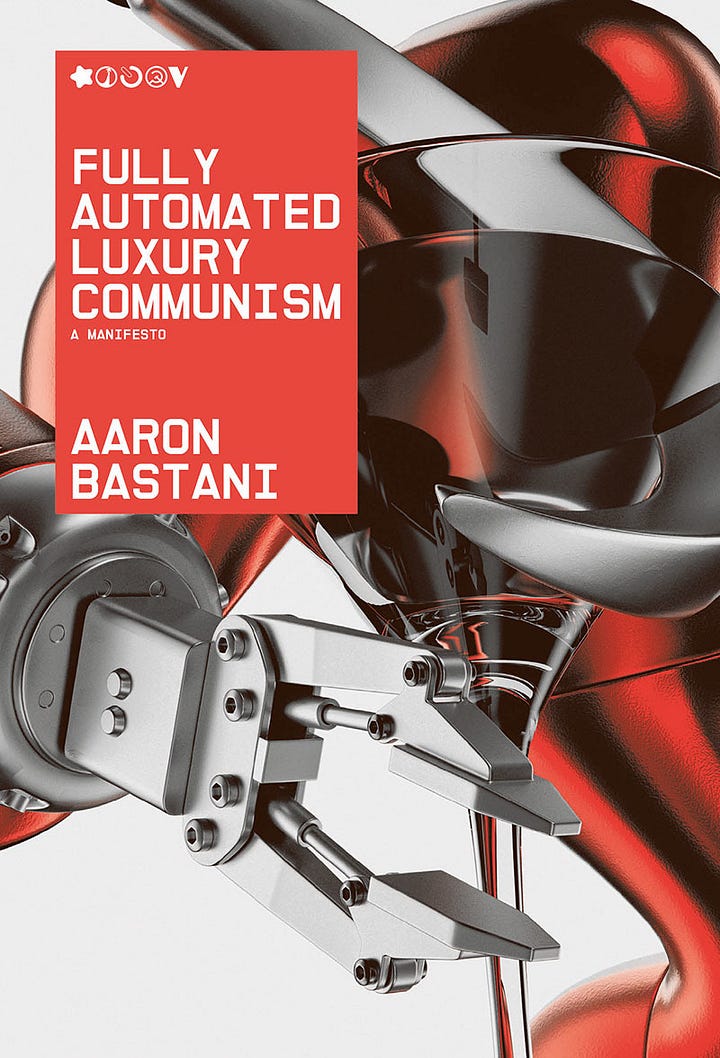
Klein and Thompson cite Fully Automated Luxury Communism in the introduction to Abundance:
Our era features too little utopian thinking, but one worthy exception is Aaron Bastani’s Fully Automated Luxury Communism, a leftist tract that puts the technologies in development right now—artificial intelligence, renewable energy, asteroid mining, plant- and cell-based meats, and gene editing—at the center of a post-work, post-scarcity vision. “What if everything could change?” he asks. “What if, more than simply meeting the great challenges of our time—from climate change to inequality and ageing—we went far beyond them, putting today’s problems behind us like we did before with large predators and, for the most part, illness? What if, rather than having no sense of a different future, we decided history hadn’t actually begun?
The lineage of these ideas offers a unique, decade long case study for how political ideation begins among theorists, becomes memeified by the internet, and eventually find its way into real world politics.
In contrast to it’s more philosophically minded predecessors, Abundance explores the granular policy quagmires that obstruct American society from accomplishing many of its stated goals; clean energy, automation and new innovations in the fields of science and technology.
Similar to other works in the genre, the authors advocate for a Promethean productivism that seeks to increase living standards. Rather than, cut carbon emissions by limiting construction, consumption and air travel, they support state-led investment into green technologies at the scale of DARPA under the New Deal.
Today’s activist left makes a grave mistake when it lends support to consumption cuts and calls for a reduction in living standards. These policies are broadly unpopular and often work to empower right-wing populist figures. In 2021, Xtinction Rebellion protested and temporarily shut down a La Farge cement factory in Paris. They hung hand painted signs with slogans like; “Build to Death”. In late 2022, climate activists attacked another cement factory in France and caused significant damage to the grounds. With the rise of these scarcity-minded (or neo-malthusian) factions, the left cedes important territory to the right.
In 2023, Marc Andreessen, a venture capitalist and founding partner at A16Z, published the Techno-Optimist Manifesto. In a cultural and political era that is fixated on doomer and dystopian imaginings of the future, Andreessen’s polemical text stands out as a positive and proactive vision. Importantly, it corresponds to a broader deflation on the political left. Many of us have abandoned hope that technology could ever be harnessed toward more progressive ends. This messaging void leaves open a key field that should be contested rather than haplessly handed over to our political opponents. The left should meet Andreessen’s argument with its own affirmative proposal.

In my reading, the critique presented by Klein and Thompson goes something like this: while the resources and productive capacity to accomplish technological goals does exist, US state capacity has been hollowed out and much of our expertise has been lost. Additionally, superpower competition in the 21st century, will force the US to heavily invest in science and technology.
Already, the American model lags behind the rest of the advanced world. Certain legal frameworks that were constructed in the 1970s, particularly in the case of environmental building codes, have coalesced into a baroque regulatory stack that obstructs large scale infrastructure projects like high speed rail and solar farms.
When it comes to high speed rail, the US has fallen behind similarly developed countries in northern Europe and particularly far behind when compared to China. The authors write:
It costs about $609 million to build a kilometer (about 0.6 miles) of rail [in the United States]. Germany builds a kilometer of rail for $384 million. Canada gets it done for $295 million. Japan clocks in at $267 million. Portugal is the cheapest country in the database, at $96 million.
In contrast, a kilometer of high speed rail could cost as low as $17 - 21 million in China.
For more information on state capacity and the American innovation ecosystem, I recommend Mariana Mazzucato’s The Entreprennial State (2011). “Innovation ecosystem” is a fancy term for the complex and nested relationships between the state and private sector in the fields of science and technology. The system governs important functions like R&D, grants and other large scale investments. Contrary to the pitch decks that emerge from silicon valley start ups, American innovation seems to have boomed under the previous state-led model of DARPA. The Defense Advanced Research Projects Agency is a research and development agency in the US that was responsible for many of the transformational technologies that we use today, like the internet and GPS.
In this new era of superpower states, a New Deal-style R&D program will be necessary to compete. Many of our most popular and lucrative technologies, like the iphone, are built on top of massive government investments from decades earlier. In her book, Mazzucato explores this history, offers several corrective measures and compares the failing US system to other competitive models throughout the world.

Curiously, Abundance takes a heterodox approach to solving many of our political and economic problems. We are not used to hearing arguments for supply side economics from self-described progressives. This deregulatory approach is generally something that we associate with free market Republican-type politicians. Throughout the book, the authors argue that the failures of Democratic governance has strongly contributed to the rise of right-wing populism. The Democrats inability to deliver on their many promises has caused them to hemorrhage support across several election cycles. Blue states have been largely unable to build housing, green energy or high speed rail. California, the largest blue state stronghold, is now losing residents to red states like Texas.
In a society that offered greater social democratic services, in which a larger portion of the material well-being available to citizens was removed from the market and guaranteed as a right of citizenship, our individual incentives to protect NIMBY property values would be vastly reduced. A drop of healthcare might grant us an ocean of solar panels.

Around fifteen years ago, when I first took a serious interest in political theory, it was inconceivable that anyone with a mainstream audience would even say the word “neoliberalism” . This political-economic consensus was so deeply ingrained that it could not be named. Simply put, there was no alternative.
Its an important marker of our time that journalists and politicians are now eagerly and articulately describing the New Deal and neoliberal periods as distinct eras. It opens up the ideological terrain for what can come next. In particular, I want to highlight this quote from Klein and Thompson toward the book’s conclusion:
Comparatively, abundance is a return to an older tradition of leftist thought. In The Communist Manifesto, Karl Marx and Friedrich Engels acknowledged that capitalism was superior to its predecessor, feudalism, at producing goods and wealth. “The bourgeoisie, during its rule of scarce one hundred years, has created more massive and more colossal productive forces than have all preceding generations together,” they wrote. They did not want to end this revolution in production. They wanted to accelerate it.
Just as feudalism blocked production that only capitalism could unleash, so did capitalism constrain an abundance that a new paradigm might unleash. Core to this analysis of the economy was an idea that has come to be called the “fettering of production.” Marx observed that many companies’ obsession with profit kept the entire economy from exploring ideas that threatened incumbent margins or failed to produce immediate returns. Among capitalism’s many sins, Marx wrote, was that it prevented the most wondrous and useful technology from being invented and deployed in the first place. An economy run amok with useless fettering serves the rich few at the expense of the poorer many.
Marx’s aim was not to turn the production machine off, but to direct its ends toward a shared abundance: to unburden the forces of production and make possible that which had been impossible to imagine. There is much he got wrong, but one need not be a communist to see the wisdom in this analysis.

Abundance is a policy platform for Democratic party politicians in the next decade. It serves as a left-liberal counter to the techno-optimism of the right. It is not (nor is it intended to be) an instructional manual for class struggle. The task for the social democratic left remains -- as it was before and shall stay for the foreseeable future -- to build the labor movement. I've spent many years talking with people from the distant corners of the political spectrum. To me, hearing parts of your program echoed by another faction is a deeply positive development because it increases your own chance to win.
What we should ask ourselves is — does this Neo New Deal, Green National Security Keynesianism or whatever we decide to call it, aid in the struggle to build up labor? The essential left accelerationist insight is to identify the competitive dynamics within capitalism and find key points at which to intervene. For example, when the US brings back the production of green energy technologies, we will have a sector of manufacturing that cannot be offshored. What can we do now to ensure that these jobs and factories will be a stronghold for robust trade unionist politics? This is how we invent the future.
***
If you’d like some further recommendations in this genre you can find a few of my previous book lists here:
Syllabus: Artists After the Internet v.2020-1
Syllabus: DoNotResearch, 2021-- fall
Syllabus: DoNotResearch, 2022-- summer
Fitness Program & Syllabus: Summer 2024
Malthusianism aside, the inconvenient truth at the heart of degrowth’s premise remains pretty much irrefutable: the earth’s resources are finite. No “clean & renewable” techno-solutions will ever be able to magically bypass this fundamental constraint, we can’t greenwash our way out of this. It’s telling that the same people who fancy themselves pragmatic when they frame this and that redistributive or environmentalist policy as unrealistic, are deeply invested in defending the necessity for constant “growth,” in defiance of the most elementary reality principle. I have yet to hear anyone make a convincing case of how we ought to build a sustainable future that does not entail setting caps on production. To argue for limits—beginning with limits on how much plundered wealth can be accumulated and made artificially scarce by oligarchs, rent-seekers, and monopolists—does not have to be a petty-bourgeois puritan Malthusianism, quite the opposite. It actually is an indispensable part of any true “abundance” agenda. Unfettered productivism is actually the real scarcity-minded ideology dooming us to a future of famines. To say it is not to argue against “abundance” (whatever is meant by this catchword). And surely there are leftists who think in a Malthusian way, but that’s not the heart of the question. Your analogy (degrowth = Malthusianism) is a bit off-putting in the way it suggests a reduction of the question of production to the natalism debate. I’ve heard this before from people arguing that degrowth is “anti-life.” But there is a very consistent argument to be made that it is this sinister utilitarianism you are defending which is the enemy of life (I say sinister at the thought of drones delivering Ozempic, antidepressants, and lab-grown meat to our door as the utopia Ezra Klein seems to think we all aspire to). As for invoking Marx, his older self seems to have moved beyond this dogmatically productivist mindset and the idea that capitalism was this indispensable stage on the path to socialism (arguing that traditional peasant villages in Russia could be a blueprint for future revolution). I have not read Ezra’s book, so I’ll resist unpacking all the red flags and inconsistencies that seem so flagrant. But from what you have laid out, I don’t see why this DNC-aligned technocratic wet dream—which very much rhymes with things we’ve heard before from the same people—would resonate that much more with the abstract “average voter” than the idea of setting limits to wealth accumulation, to the plundering of the soil, or to building for its own sake (as in “removing red tape”). Forgive me for doubting Ezra Klein's populist flair, but no matter what we choose to assume is so rigidly unpopular with the masses according to centrist wishful thinking, I don’t think companies like Lafarge are necessarily more popular than the leftist and NIMBY activists that resist them. Regardless, left politics should imply a long-term struggle for collective education and resetting the terms of debate, not simply meeting voters wherever the legacy media and political establishment has decided they are (while it also consistently chooses to ignore blatantly popular propositions like universal healthcare). Lafarge and the industry they are a part of successfully lobby to convert woods, swamps, or agricultural lands into fucking malls and airports which have no essential use value at all—for the sake of a “growth” intractably tied to the myth of trickle-down profits. And if Ezra Klein’s pseudo-leftist embrace of supply economics sounds incompatible with a consistently left-wing agenda, it’s because it very likely is. Like implying that the housing crisis is simply an issue of needing to build more housing (the real estate industry’s long-held self-serving argument to be allowed to build more of the crappy unaffordable condos that are already rampant in places like New York) rather than a distributive problem that is intertwined with capital accumulation and financial speculation bubbles. I agree with a lot of your remarks, like pointing out the Cold War side of “abundance” (which was also the point of Build Back Better), but it's not clear why this would be a reason to be enthused about it—Cold War contradictions were already what brought down the Liberalism of the Great Society, I don’t see why things would be different now. Anyway, appreciate the open mind, but we should know better than to take all this centrist “third way” drivel at face value, “neoliberalism” or not.
Good discussion, I'm excited to listen to the subscriber version soon. We are in maybe the strangest political climate of my lifetime, so this book seems like good timing. I just hope it actually influences actual democratic policy positions in 2 and 4 years